Personality Development

In the Name of Allâh, the Most Beneficent, the Most Merciful
|
From Sahl ibn Aa'd who said that Allâh's Messenger (salAllâhu 'alaihi wa'sallam) said:
Reported by al-Haakim (4/324) |
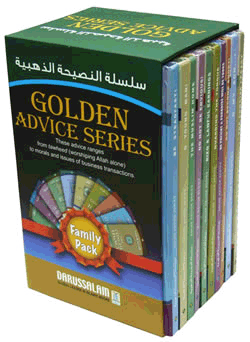
Golden Advice Series
THE GOLDEN ADVICE SERIES is a response to the obligation of giving naseehah (good advice) and its obvious need in our ummah at the present time. This series focuses on the naseehah to the believers from the Glorious Qur'an and the Sunnah of the Prophet Muhammad (S). These advice ranges from tawheed (worshiping Allah alone) to morals and issues of business transactions. Each of the books comes in an easy-to-read size but the contents are highly beneficial, bi ithni'llah! |
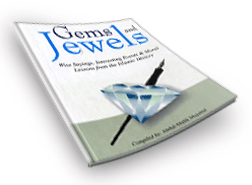
Gems and Jewels
Author: Abdul Malik Mujahid | Pages: 319 | Size: 8 MB Wise Sayings, Interesting Events & Moral Lessons from the Islamic History. Excerpts and passages collected from many books written by the scholars of the Islam have been compiled in this book. The writings will be of equal interest to all Muslims whether they are Children or Adults, and similarly they will gain a lot of virtues, develop good character patterns, and adopt intellectual behavior in their lives from the examples of the great personalities of Islam. |
|
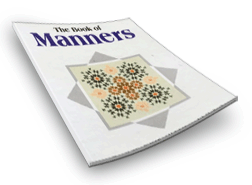
Book of Manners
Author: Fu'ad Ibn 'Abdul-'Azeez Ash-Shulhoob | Pages: 500 | Size: 15 MB Among the many good deeds that the Prophet (S) guided us to and the evil that he (S) warned us about, are a set of manners that are comprehensive of worldly matters and religious matters, of worship and dealings - dealings with one's family, children, acquaintances, and strangers. On this subject the writings of great scholars like Ibn Al-Qayyim Al-Jawziyyah, Ibn Muflaih and As-Safaareenee have been summarized in this book. |
|
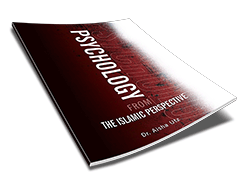
Psychology From The Islamic Perspective
Author: Aisha Utz | Pages: 349 | Size: 18 MB Psychology is one of the most intriguing scientific disciplines humans are inherently curious about their own nature. Ironically, there are a multitude of theories and explanations that mislead and confuse the very same creatures that they are meant to describe. Allah has blessed us with guidance in all facets of our lives, including that of our own souls and psyches. Islam offers an uncomplicated, comprehensive, and precise theory of our spiritual nature, our purpose and priorities in life, and how we can attain serenity and happiness in this life and the next. This book is a humble effort to expound upon the true conceptualization of human psychology based upon the Qur'an and the Sunnah. Moreover, Dr. Utz includes specific references to scientific research that corresponds to, and builds upon, what is already known from revelation. |
|
The True Secret
Author: Amira Ayad | Pages: 294 | Size: 12 MB As Human Beings, We all desire happiness, success, health, and peace of mind. As Muslims, we strive to live every aspect of our lives in accordance with our Islamic beliefs in order to earn the pleasure of Allah and reach Paradise in the next life. Just how do we go about accomplishing all this, though? How do we get from where we are to where we want to be? The True Secret offers practical step-by-step program that you could use to evaluate your situation and begin to make changes in beliefs and actions, working towards success in this life and the next. The examples, tools, and explanations are in accordance with authentic Islamic teachings and yet, still, not surprisingly, in accordance with the latest scientific researches and recommendations. |
|
The Productive Muslim
Author: Mohammed Faris | Pages: 209 | Size: 3 MB Ever wondered if there's a practical way to lead a productive lifestyle that combines the best of Islamic tradition and modern psychology and science? In "The ProductiveMuslim" Mohammed Faris, the founder of ProductiveMuslim.com, provides this practical framework that helps urban global Muslims lead a productive lifestyle  Spiritually, Physically, and Socially. |
|
Discipline: The Path To Spiritual Growth
The inner fight against the self takes place in every human being daily, however only the sincere and powerful will do away with such impulses and attacks and will overcome the forces of desire. Just like food, drink and clothes are a necessity for the human being, so too is the need to discipline the soul and rectify the flaws of the self. In today’s society people often neglect the self and the need for it to be reformed upon the teachings of the Qur’an and the beautiful example of our beloved Prophet (peace and blessing be upon him) and his Companions. |
|
Islamic Etiquette
Author: Abu Bakr Jabir Al-Jaza'iry | Pages: 166 | Size: 37 MB This is a portion of Abu Bakr A1-Jazairi's well-known and well-accepted work Minhaj-ul-Muslim - "The Way of the Muslim." The Author has pointed out that Islam is a religion of etiquette and touches upon almost every deed of Islam in relation to the most related customs of a particular time and place. The Author has urged that in Islamic culture a Muslim should have to pay all his duties in this sense. The Author has described all the Islamic attitudes required by a Muslim especially intention, behavior towards Allah, towards one's parents and his children, relatives and neighbors. |
|
A Reference Guide for Character Development
Author: Dr. Feryad A. Hussain | Pages: 393 | Size: 17 MB In A Reference Guide for Character Development, Dr. Feryad A. Hussain blends modern psychology with verses from the Qur'an and authentic hadiths. Through an Islamic reframing of eighty-five therapeutic themes - including self-control, patience, accepting advice, anger/aggression, being grateful, confidence, coping, flexibility, guilt, and many more - Dr. Hussain draws on her extensive experience as a clinical psychologist to offer alternative understandings based on Allah's message to humankind. The text provides logic and divine comfort to help clients and therapists resolve their issues through faith, contemplation, and prayer. |
|
Managing Your Emotions
Author: Dr. Feryad A. Hussain | Pages: 218 | Size: 9 MB Managing Your Emotions is an Islamically-centred self-help approach to managing difficult emotions. These are experienced by most, if not all, of us due to the pressures and demands we face in our modern, complex society. Using examples from her clinical experience with patients, Dr. Feryad A. Hussain presents a wide range of emotions - including anger, sadness, and fear - to connect her ideas to key therapeutic approaches to provide an Islamic framework for their implementation in personal character development. |
|
Recognising and Changing Destructive Behaviours
Author: Dr. Feryad A. Hussain | Pages: 385 | Size: 15 MB Recognising and Changing Destructive Behaviours uses verses from the Qur'an, selected hadiths, and modern psychological theory to bring to light detrimental behaviours and guide readers in altering action through thought. Dr. Feryad A. Hussain takes ideal Islamic behaviour as a goal and presents realistic and practical advice and steps towards attaining this objective. She steers readers towards reflecting Islam in their thoughts and actions, keeping their lives in this world and the hereafter in mind. |
|
Therapy from the Quran and Ahadith
Author: Dr. Feryad A. Hussain | Pages: 325 | Size: 8 MB A reference guide for character development. Discusses more than 85 therapeutic approaches for treating mental illness in the light of Islamic teachings. A practical workbook that helps see the most common psychological problems in a spiritually meaningful manner. "Dr. Feryad is a young woman of the new Islamic generation born and raised in the West. She holds a doctorate in Clinical Psychology and has worked as a clinical psychologist for a number of years... Clinically she adopts an eclectic approach to treatment, including Cognitive Behavioural Therapy, Humanistic Therapy, Psychodynamic Therapy (Kleinian) and Solution Focussed Therapy and is gifted in giving them an Islamic orientation." (Prof Malik Badri, International Islamic University, Malaysia). |
|
The Evil of Craving for Wealth and Status
Author: Ibn Rajab al-Hanbali | Pages: 40 | Size: 1 MB Many a man has led his soul into destruction by that which he covets. Desiring the riches of this world, recognition and authority amongst the people – it was a trial for the nations of the past and many of us relentlessly chase after it today. We hope that this valuable book highlights the evil consequences of craving after wealth and status and how that can corrupt the Deen of the Muslim. We pray that this realisation causes our brothers and sisters to race one another in hastening towards forgiveness from Allaah, seeking the best provision in the Hereafter – aameen. This is the English translation of the book Sharh Hadeeth Maa Dhi`baan Jaa`I’aan.. (Explanation of the Hadeeth: Two Hungry Wolves…”) by the esteemed scholar of Ahlus-Sunnah wal Jamaa’ah, Imaam al-Haafidh Ibn Rajab al-Hanbalee (d.795h). |

The Way to Patience & Gratitude
Author: Ibn Qayyim Al-Jawziyyah | Pages: 517 | Size: 10 MB
Patience and Gratitude are the keys to success in this world and the next, as Imam Ibn Qayyim Al-Jawziyya explains in a beautiful Manner in this Book.
In the name of God, Most Gracious, Most Merciful
By the Time,
Verily Man is in loss,
Except such as have Faith, and do righteous deeds,
and (join together) in the mutual teaching of Truth,
and of Patience and Constancy. |
|
Dealing with Lust and Greed
Author: Abd al-Hamid Kishk | Pages: 148 | Size: 12 MB According to the teachings of Al-Islam, the desires and appetites play a vital part in the makeup of every human being; they cannot be ignored. The children of Adam, unlike the angels, face the challenge in this life of mastering these forces within us. If we fail to do so, then we become the servants of our appetites and thus fall below the level of the animal kingdom. |
|
..So, Do Not Fear Them!
Author: Abu Muhammad al-Maqdisi | Pages: 16 | Size: 1 MB "So do not fear them, and fear Me if you are believers". An Encouragement to Be Firm on the Truth, Openly Express It, and to Not Fear the Helpers of the Tyrants. Translated by Abu Sabaya. |
|
The Scales of Allah
Author: ‘Abdullah ‘Azzam | Pages: 22 | Size: 1 MB By the martyred Imam ‘Abdullah ‘Azzam (May Allah have Mercy upon him). “…This is the cream of the people. Search for it. Live with it. Travel with it as your guide and under its leadership. Worship Allah by way of the light that you see and hear from them…”. Translated by Abu Sabaya. |
|
Being True With Allah
Author: ‘Abdullah ‘Azzam | Pages: 20 | Size: 1 MB By the martyred Imam ‘Abdullah ‘Azzam (May Allah have Mercy upon him). “…the biggest problem facing Islam today is the lack of the sincere and truthful amongst those who are working for Allah, except for those few hidden, pious, and pure people who were made for leading nations, and were made for navigating the ship…”. Translated by Abu Sabaya. |
|
From the Characteristics of the Salaf
Author: Sheikh Ahmed Fareed | Pages: 125 | Size: 5 MB This book offers a glimpse into the lives of those who have been praised by both Allah and His Messenger in general. Written in easy English and specially adapted for those who speak it as a first language, it is an invaluable aid to developing one’s character in the footsteps of those who lived and worshipped Allah honourably. It is based on an original Arabic compilation and has been checked for authenticity. People of all ages and learning should be able to benefit from this book. The style facilitates vitally needed reflection on this topic and makes for a great gift to anyone for whom we care. |
|
Difference Between Advising and Shaming
Author: Ibn Rajab al-Hanbali | Pages: 95 | Size: 5 MB In this notable work, the renowned author provides essential detail in discussing key points dealing with differences that arise between the People of Sunnah, and the manners and etiquette one should acquire when differing occurs. He beautifully illustrates the difference between advising that is encouraged, and shaming that is not permitted – two topics that often become tangled and misunderstood. The author thus explains the characteristics of sincere advice and censure with a depth of clarity that will no doubt bring benefit to all, particularly those involved in active da’wah. |
|
Sketches Of Fools And Simpletons
Author: Imam Ibn Jawzi | Pages: 98 | Size: 2.5 MB Lack of sense leads to acts of foolishness, allowing them to mothball into comical gags. Ibrahim Al-Nazzam was once asked, "What are the limits of foolishness?" To which he replied, "You asked about that which has no limits." The art of humour is an intricate balancing act between folly and good judgement, measure and discomposure. People of virtue have always enjoyed a chuckle and hearty anecdotes, remaining positive towards them because they relax the mind and comfort the heart from fatigue of contemplative thought. Even the joshing nature of the Prophet (peace and blessings be upon him) is well-known, yet it was guided by a higher code of conduct cognisant of personal and public responsibility. Purposeful joking and jest brings benefit just as salt in food, ever careful not to be excessive. Before you therefore, is an amusing classical text reflecting a sharp departure from the usual scholarship for which the author is known for. Compiled in the sixth century Hijri, this collection of irreverent and playful sketches - derisive and cynical observations of mischievous people - are sure to tickle your funny bone, albeit having a more sober purpose for the reader to contemplate |
The Prophet's Methods Of Correcting People's Mistakes
Author: Muhammad Salih al-Munajjid | Pages: 65 | Size: 1 MB There are many teaching methods with different means and aids. Correcting mistakes is one of these teaching methods and educationalists call is the "remedial method." Correcting people's mistakes is essential if teaching people is the aim. Correcting mistakes is a divine method the Prophet (pbuh) practiced as the Qur'an was sometimes revealed to correct some mistakes of the Sahabah (companions of the Prophet). The Prophet (pbuh) was divinely guided in correcting the mistakes of people. So his methods are the best mankind has ever known. Following the example of the Prophet (pbuh) is therefore the best approach if one is really keen to teach Islamic knowledge and all the other branches of knowledge. The author has in this book compiled many methods of the Prophet (pbuh) for teaching people and correcting their mistakes. This book, as such, is indispensable for everyone who is concerned with education in general, and Islamic knowledge in particular. |

Dealing with Worries and Stress
Muhammad Salih al-Munajjid
It is the nature of this life that people will suffer from worries and stress, because this world is the place of disease, hardship and suffering. It is also the nature of this life that people have to put with suffering and hardship for various reasons. So people feel regret for what has happened in the past, anxious about that may happen in the future, and worried about what is going on in the present. The things that cross our mind and make us feel distressed are things in the past that have caused grief, things in the future that we are worried about, and things in the present which concern us.
|
Trials and Tribulations : Wisdom and Benefits
Author: al-Imam al-'Izz bin 'Abdus-Salam | Pages: 63 | Size: 1 MB A wonderful treatise on the reality and causes of trials and tribulations, their reasons, their benefits, there results and the correct understanding and approach towards them. People often see, and hear of, the believers being afflicted with adversity and tribulations, and conversely they often see, and hear of, the disbelievers attaining leadership and wealth in this world. This leads them to believe that well-being in this world is only reserved for the disbelievers and only a fraction of it is given to the believers; and also to believe that nobility and might is for the disbelievers in this world and for the believers in the Hereafter. |
|
Lying & Envying
Author: Abdul-Malik Al-Qasim | Pages: 48 | Size: 4 MB Truthfulness and kindness are the signs of happiness of the nation and the individual. The key to happiness is sincerity and compassion, while misery is associated with lying and envying. Allah has not blessed any person with a blessing after Islam greater than truthfulness and kindness. Allah has never tried a person with something worse than lying and envying, All forms of lying and envying have been discussed in this publication and the teachings of Islam have been elaborated regarding all these forms and how to cope with them in day-to-day life activities. |
|
Backbiting and Its Adverse Effects
'Ghibah is not an easy term to translate- there is no single equivalent word in English, although it may be loosely covered by the term Backbiting (Ghibah) also includes Gossip, slandering, scandal-mongering, etc. Whichever word we chose, we cannot escape from the fact that Ghibah affects us all. We have all been victims and - we must be honest - we have all been guilty of this sin. But it is not a matter to be taken lightly - Backbiting can wreck lives and shatter communities. If we seek to unite as Muslims, we must combat Ghibah. Islam is a practical faith which recognizes the human conditions and offers achievable remedies to the problems that beset us. Every human society faces the problem of gossip, and Islam shows us how to tackle it in a sensible and humane manner. [At-Tirmidhi] |
|
The Many Dangers of the Tongue
Compiled by Imraan Hussein. May Allah, the Most High assist us to purify our tongues, and avoid its evil consequences. According to Ibn`Umar, the thing that needs the most purification by any person, is his tongue. Let us guard our tongues from these evils, lest our works be destroyed. Remember the statement of the Prophet (peace be upon him) to Mu`aadh, may Allah be pleased with him:"...then he (peace be upon him) said "Shall I not tell you of what control all that? I said: "Yes, O Messenger of Allah, and he took hold of his tongue and said: "Restrain this. " I said "O Prophet of Allah, will what we say be held against us? He (peace be upon him) said: "May your mother be bereaved for you, O Mu'adh! Is there anything that topples people on their faces - or he said on their noses - into the Hell fire, other than the harvest of their tongues. " [At-Tirmidhi] |

|
Kindness & Gentleness
Author: Dr Fadl al-Ilaahi | Pages: 118 | Size: 8 MB Undoubtedly, the heart leans towards those who are kind and gentle. It was said a long time ago: "Make your face happy and your words gentle, and you will be more beloved to the people than those who give them a gift". Likewise, it is a part of human nature to turn away from severity and harsh heartedness even if it were to come from (our Prophet who is) the best of Allaah the Most High's creatures. Allaah the Most High says: "...And had you been severe and harsh hearted, they would have broken away from you..." The one calling to the religion of Islam and dealing with other people has the utmost need to gather the people around him, and cause their hearts to lean towards him so that they will listen to him. Adorning himself with kindness and gentleness helps to achieve that goal with the grace of Allaah. |

|
Road To Good Friendship
Author: Abdul Malik Al-Qasim | Pages: 55 | Size: 12 MB The distinguished feature of the booklet is to enhance the good friendship in society. The Author has selected the illuminating sayings of the Prophet (S) and those of his companions and the Salaf. These advices will encourage good friendship in the Muslim society and will open the door wide to establish a civilized Islamic culture. This society based on true friendship will breed justice, equality and love for humanity. |

|
Hindrances On The Path
Author: Abdul Malik Al-Qasim | Pages: 56 | Size: 12 MB Hindrances on the Path is a very enlightening booklet by Abdul Malik Al-Qasim. He has collected several stories and narrations that demonstrate the Islamic society. There are many small but very important social manners, which we deal with wrongfully. The Author has pointed out very silently but in a typical manner, just like: neglecting the rights of the neighbors, exposing one's secrets, interfering in the affairs of others, evil talking, etc. |
Al-Akhlâq wa’l-Siyar (Morals and Behaviour)By Ibn Hazm al-Andalusi. I have gathered together in this book numerous ideas which Allâh, the provider of intellect, has enabled me to profit from as day succeeded day, [and year succeeded year] and circumstances altered, permitting me to understand the vicissitudes of fate and to control its fluctuations, to the extent that I have devoted the larger part of my life to it. I have chosen to master these problems by study and contemplation, rather than throw myself into the various sensual pleasures which attract most souls on this earth, and rather than amass unnecessary wealth. I have gathered together all my observations into this book in the hope that the Almighty may allow it to benefit whichever of His servants He wishes who has access to [is capable of understanding] my book, in the matters over which I have slaved, devoting all my efforts to them and reflecting at length upon them. I hope that it will be well received, and I present it with good intentions and blessings [with a good heart]. |
Anxiety
Stress, worries, fears and miscellaneous can weaken a person’s iman. Rafil Dhafir explains how Allah can help a person though any trial, bringing ease after hardship. This lecture provides details regarding the dependent relationship a person has with his creator, as well as many practical remedies for stress. |

Extremism
Jamal Zarabozo In this series of lectures, Shaykh Jamaal al-Din Zarabozo presents an in-depth study of one of the most vital topics for Muslims in West: Religious Extremism. These eight presentations provide one of the most detailed analyses of the subject to date. Being thoroughly accurate, Shaykh Zarabozo imbues a high academic standard, thereby quenching the intellectual thirst of the listener. The topics covered include the following: 1- Important Concepts of Extremism Defined. 2- The Shariah's Prohibition of Extremism. 3- Manifestation of Extremism. 4- The Concept of Extremism. 5- The Evils of Extremism. 6- The Solutions for Extremism. |
Envy: Al-Hasad
Jamal Zarabozo In this series of lectures, the speaker first explains the central role of the heart and the dangers of diseases in the heart. Next comes an indepth discussion of the concept of hasad and its evil consequences. This is followed by steps one can follow to remove this disease from one's heart. Finally, the positive aspects of the obligatory hasad, competing in good deeds and sacrificing for the sake of others-the antidote to hasad-are discussed. |

Self Image Psychology
Self Image Psychology expounds on some of the harmful messages promoted by the western media. The speaker points out how these common messages damage the Muslims’ self-image psychology. Among the many things discussed in this presentation are examples of proper self-respect and self-reverence from the lives of the Companions of the Prophet Muhammad (s). In addition, the speaker mentions common acts that entail lack of self esteem, such as the changing of Muslim names to non Muslim ones and the changing of the Islamic identity in general. The mere nature of this discussion reveals how Muslims today really view themselves. |

Featured Article
|
"Know that not everyone is suitable to be your friend..."
|






